This is the first of a set of articles walking through a typical study of TALE diversity: finding TALE genes in a genome (here), classifying the arrays found into groups of related sequences, aligning those groups, and predicting the DNA targets of the TALEs they contain. The other articles in the set are side branches: deep dives into a single class (tales, tales_msa) and one case study on naturally truncated TALEs. Each is linked from the point where it becomes relevant.
This article covers TALE discovery with AnnoTALE and tell_tales(). Because of their repetitive nature tal genes cannot be assembled from short read sequencing technologies data. This is why now most of the genomes of tal bearing bacteria are sequenced with long read technologies which may be error prone. Those assemblies are not always clean, and tell_tales() can sometimes be fooled. tantale offers two ways to correct frameshifts. They work differently, neither is guaranteed to succeed, and tales_anomalies() tells you which arrays still need attention after either one.
The genomes used throughout
Four Xanthomonas oryzae genomes appear across this set of articles: MAI1, BAI3 and PXO86 are “clean” assemblies, and BAI3-1-1 is a deliberately error-prone one: an assembly of the same BAI3 background with a deleted tal locus, carrying real sequencing/assembly artefacts in its TALE loci. A mining pipeline meets this kind of input routinely in practice, and it is what the second half of this article is about.
1 AnnoTALE, the standard tool
AnnoTALE is the standard tool for finding and annotating tal genes in bacterial genome sequences. Its predict stage locates TALE genes in a genome and flags those likely to be pseudogenes. Its analyze stage splits each predicted protein into its N-terminal region, repeats and C-terminal region, and reads the RVD of every repeat. A third stage, build, assigns TALEs to the classes of the AnnoTALE nomenclature. tantale runs the first two with run_annotale_predict() and the third with run_annotale_build(), and tales_from_annotale() turns the output of predict into a tales object. tantale ships AnnoTALE’s output for four TALEs of BAI3:
Code
annotale_example <- system.file("extdata", "annotaleExampleOutput", package = "tantale")
bai3_sample <- tales_from_annotale(annotale_example)
bai3_sample
#> <tales> 4 arrays, 96 parts
#>   layers: rvd   |   6 other columns
#>                                 rvd
#>   bai3_sample_tal_genomic_regions-tempTALE1  NTERM NN NG NN HD HD NI N* NG HD NI NG NN  ...
#>   bai3_sample_tal_genomic_regions-tempTALE2  NTERM NN HD NI NN HD NG HD HD NG NG NI NG  ...
#>   bai3_sample_tal_genomic_regions-tempTALE3  NTERM NN ND NN NI NK NN HD NN NG NG N* HD  ...
#>   bai3_sample_tal_genomic_regions-tempTALE4  NTERM NI HD NN NS NN NG HD NG HD NG NN NG  ...
tell_tales() searches each terminal region with the profile HMM of the TALE N- or C-terminal domain, and marks it NTERM or CTERM when it is a canonical terminus, one that can be expected to do its usual job: the match must cover at least 90% of the profile (XXXXX otherwise). A terminus that has lost a large part, like the C-terminus of a truncTALE, is coded XXXXX even though it is related to a TALE terminus (see Genuine truncTALEs). On a whole genome, the same object comes from two calls (not run here, as predict takes a couple of minutes per genome):
Code
mai1_annotale_dir <- file.path(tempdir(), "MAI1_annotale")
run_annotale_predict(tantale_genome("MAI1"),
                     output_dir = mai1_annotale_dir)
mai1_annotale <- tales_from_annotale(mai1_annotale_dir)
On the clean BAI3 assembly, AnnoTALE predicts nine TALEs, none flagged. On BAI3-1-1, the error-prone assembly of the same background, it predicts eight and flags all eight as putative pseudogenes. tell_tales() is built for such genomes. It locates candidate arrays with DNA profiles of the three TALE regions before any ORF is predicted, reports the DNA evidence for each array (which terminus profiles matched, how much of the region the longest ORF covers), can correct frameshifts in each array before AnnoTALE analyze reads it, and keeps per-array reports and terminus alignments for inspection. The rest of this article uses tell_tales().
2 Finding TALE loci in genomic DNA
tell_tales() searches a genome with nhmmer, using three profile HMMs tuned to the N-terminus, the repeat unit, and the C-terminus of a TALE CDS. It merges the hits, groups them into candidate arrays by proximity and hands each array’s longest ORF to AnnoTALE to split into parts and call its RVD sequence. It then adds terminus codes at either end of the RVD string, NTERM/CTERM for a canonical terminus and XXXXX for any other, so a downstream alignment knows where an array actually starts and ends.
A scratch directory holds everything this set of articles builds:
Code
out <- fs::dir_create(file.path(tempdir(), "tale_mining"))Start with MAI1, a clean assembly, to see what discovery looks like when nothing goes wrong:
Code
mai1_fa <- tantale_genome("MAI1")
mai1_dir <- file.path(out, "MAI1")
Code
invisible(tell_tales(subject_file = mai1_fa, output_dir = mai1_dir))The result on disk is a directory of reports and fasta files. The result in R is a tales object, with one row per part (repeat or terminus):
Code
mai1 <- suppressWarnings(tales_from_telltales(mai1_dir))
mai1
#> <tales> 9 arrays, 198 parts
#>   layers: rvd   |   6 other columns
#>              rvd
#>   ROI_00001  NTERM NS NG NS HD NI NG NN NG HD NI NN N* NI NN HD NG NI NN N ...
#>   ROI_00002  NTERM NN N* NN HD HD NI N* NG HD NI NG NN HD NS NG NI NG NN N ...
#>   ...        ...
#>   ROI_00009  NTERM NI HD NN NS NN NG HD NG HD NG NN NG HD NS HD NI NG HD H ...
#>   ROI_00010  NTERM NN HD NN HD NG HD HD NG HD NI NI NN HD HD N* NG HD NI CTERM
What a
talesobject actually isRows, columns, subsetting, and the
dom_codecolumn that the rest of tantale is built on are covered in depth in thetalesclass article – read it once this walkthrough has given you an object to look at.
plot() on a tales gives a compact overview of what was found: every array’s parts, positioned within the array, outlined by domain type and filled by amino-acid length, with the RVD printed on each repeat.
Code
plot(mai1)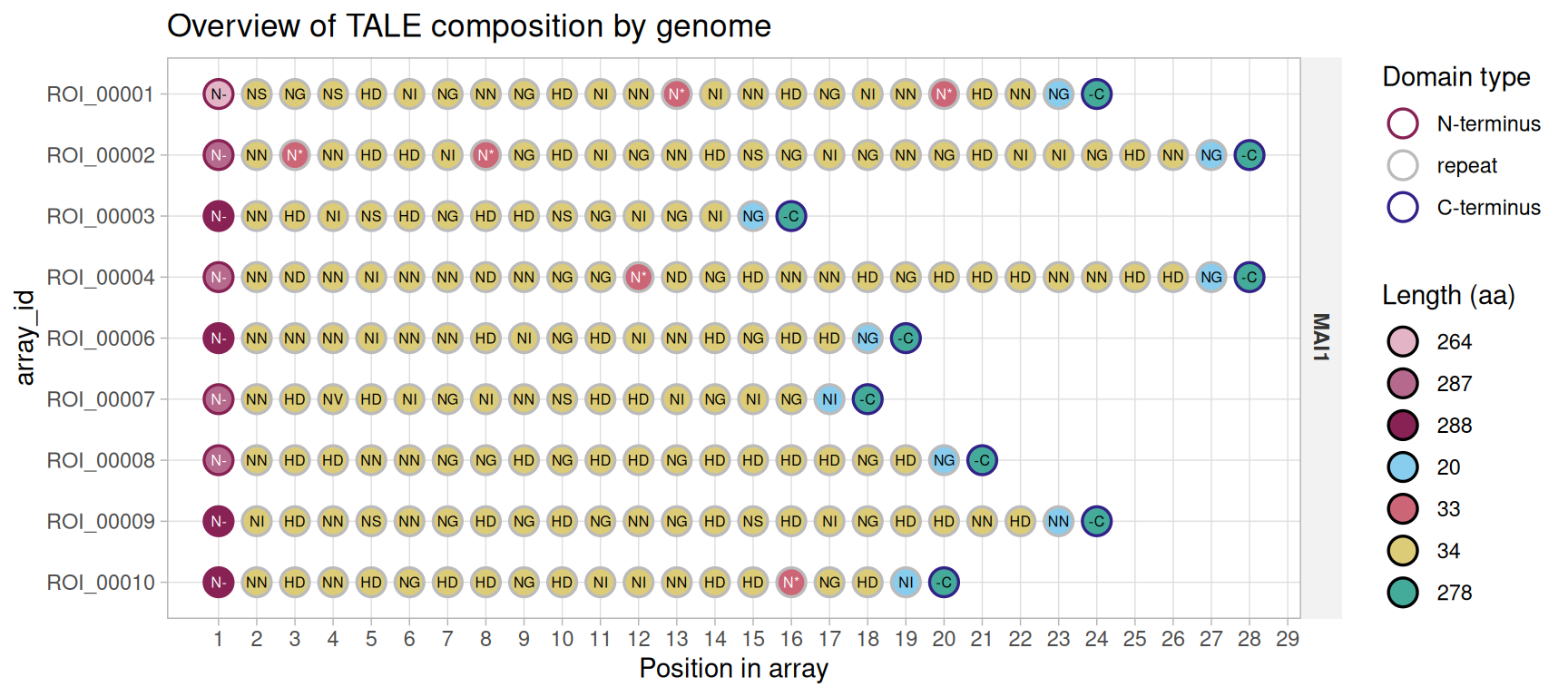
Figure 1 already shows something worth noticing: array lengths vary, from 14 to 26 repeats (counting the final half-repeat), and each array’s parts sit side by side with no gaps, because nothing has been aligned yet. position_in_array just counts parts within each array independently.
3 What tell_tales() writes to disk
Besides the RVD sequences and the TALE ORFs themselves, tell_tales() writes three tab-separated reports, which tales_from_telltales() reads back to build the object above. They are worth knowing about directly, since they carry a few things the tales object does not.
| file | one row per | worth knowing |
|---|---|---|
hits_report.tsv |
nhmmer hit |
score, evalue, the profile positions covered, codon_count, frameshift_count – before any correction |
domains_report.tsv |
domain, after AnnoTALE | what AnnoTALE actually parsed out of the ORF |
array_report.tsv |
candidate array | the DNA evidence for each terminus (*_dna_hit, *_dna_score, *_dna_cover), its protein match (*_aa_cover, *_aa_hit), has_aberrant_repeat, orf_coverage, and (with correction) predicted_ins_count/predicted_dels_count
|
array_report.tsv is the one this article leans on most, so it is worth reading directly:
Code
array_report <- readr::read_tsv(file.path(mai1_dir, "array_report.tsv"),
                                show_col_types = FALSE)
array_report %>%
  select(array_id, nterm_dna_hit, cterm_dna_hit, longest_orf_length, orf_coverage)
#> # A tibble: 10 × 5
#>    array_id  nterm_dna_hit cterm_dna_hit longest_orf_length orf_coverage
#>    <chr>     <lgl>         <lgl>                      <dbl>        <dbl>
#>  1 ROI_00005 FALSE         FALSE                         NA           NA
#>  2 ROI_00003 TRUE          TRUE                        3087           91
#>  3 ROI_00007 TRUE          TRUE                        3288           91
#>  4 ROI_00006 TRUE          TRUE                        3393           91
#>  5 ROI_00010 TRUE          TRUE                        3492           92
#>  6 ROI_00008 TRUE          TRUE                        3594           92
#>  7 ROI_00001 TRUE          TRUE                        3825           92
#>  8 ROI_00009 TRUE          TRUE                        3903           92
#>  9 ROI_00002 TRUE          TRUE                        4302           93
#> 10 ROI_00004 TRUE          TRUE                        4305           93
orf_coverage is the longest ORF found, as a percentage of the whole candidate array region length; a clean array’s ORF covers 91-93% of it here. That number is about to matter a great deal.
The report has one more row than the tales object has arrays. ROI_00005 is a candidate region with no terminus hit (nterm_dna_hit and cterm_dna_hit both FALSE) and no ORF length; it yields no parts, so it is absent from the object and from Figure 1. Using tell_tales() with a more stringent min_dna_hits or min_array_length parameter values would probably have got rid of it right away.
4 When discovery goes wrong: detecting anomalies
MAI1 is a good assembly, and every array in the tales object above came back complete. That is not guaranteed. Running the same search on BAI3-1-1, the deliberately error-prone assembly, shows what an assembly artefact does to the pipeline.
Code
bai311_fa <- tantale_genome("BAI3-1-1")
bai311_raw_dir <- file.path(out, "BAI3-1-1_raw")
Code
invisible(tell_tales(subject_file = bai311_fa, output_dir = bai311_raw_dir,
                     cterm_min_score = 300))
A first sign that there is something unexpected with these TALEs predictions are the warnings obtained when importing tell_tales results as a tales object:
Code
bai311_raw <- tales_from_telltales(bai311_raw_dir)
#> Warning: 8 arrays have biological anomalies.
#> ✖ Arrays: "ROI_00001", "ROI_00002", "ROI_00003", "ROI_00005", "ROI_00006",
#>   "ROI_00007", "ROI_00008", and "ROI_00009"
#> ℹ Reasons: terminus_noncanonical and no_repeat
#> ℹ Inspect with `tales_anomalies()`; drop with `sanitize = TRUE` (inconsistent
#>   data) or `sanitize = "canonical"` (all of them).
tales_anomalies() lists the arrays concerned and why. It reports every array that is not a standard TALE (an N-terminus, one or more repeats and a C-terminus, both termini canonical), and every array whose content is inconsistent (missing sequence data, impossible terminus arrangements, coordinate disagreements). The kind column tells the two apart:
Code
tales_anomalies(bai311_raw)
#> # A tibble: 16 × 4
#>    array_id  check                 kind         detail
#>    <chr>     <chr>                 <chr>        <chr>
#>  1 ROI_00001 terminus_noncanonical noncanonical N-terminus is not a canonical T…
#>  2 ROI_00001 terminus_noncanonical noncanonical C-terminus is not a canonical T…
#>  3 ROI_00002 terminus_noncanonical noncanonical N-terminus is not a canonical T…
#>  4 ROI_00002 terminus_noncanonical noncanonical C-terminus is not a canonical T…
#>  5 ROI_00003 no_repeat             integrity    no repeat
#>  6 ROI_00003 terminus_noncanonical noncanonical C-terminus is not a canonical T…
#>  7 ROI_00005 no_repeat             integrity    no repeat
#>  8 ROI_00005 terminus_noncanonical noncanonical C-terminus is not a canonical T…
#>  9 ROI_00006 terminus_noncanonical noncanonical N-terminus is not a canonical T…
#> 10 ROI_00006 terminus_noncanonical noncanonical C-terminus is not a canonical T…
#> 11 ROI_00007 terminus_noncanonical noncanonical N-terminus is not a canonical T…
#> 12 ROI_00007 terminus_noncanonical noncanonical C-terminus is not a canonical T…
#> 13 ROI_00008 terminus_noncanonical noncanonical N-terminus is not a canonical T…
#> 14 ROI_00008 terminus_noncanonical noncanonical C-terminus is not a canonical T…
#> 15 ROI_00009 terminus_noncanonical noncanonical N-terminus is not a canonical T…
#> 16 ROI_00009 terminus_noncanonical noncanonical C-terminus is not a canonical T…
ROI_00003 and ROI_00005 have no repeat at all: AnnoTALE could not parse a repeat-array structure out of the longest predicted ORF. The six other arrays have both termini coded XXXXX, which is not a canonical TALE terminal domain. Their orf_coverage shows why:
Code
| array_id | nterm_dna_hit | cterm_dna_hit | longest_orf_length | orf_coverage | rvd_string |
|---|---|---|---|---|---|
| ROI_00001 | TRUE | TRUE | 1764 | 38 | XXXXX-NN-NG-NN-PG-XXXXX |
| ROI_00002 | TRUE | TRUE | 2385 | 70 | XXXXX-NN-HD-NI-NN-HD-NG-HD-HD-NG-NG-NI-NG-NI-NG-XXXXX |
| ROI_00003 | TRUE | TRUE | 864 | 19 | NA |
| ROI_00004 | FALSE | FALSE | NA | NA | NA |
| ROI_00005 | TRUE | TRUE | 864 | 23 | NA |
| ROI_00006 | TRUE | TRUE | 1446 | 45 | XXXXX-NV-HD-NI-NG-NI-NN-NS-HD-HD-NI-XXXXX |
| ROI_00007 | TRUE | TRUE | 1827 | 47 | XXXXX-NN-HD-HD-NN-NN-PG-XXXXX |
| ROI_00008 | TRUE | TRUE | 2841 | 67 | XXXXX-NI-HD-NN-NS-NN-NG-HD-NG-HD-NG-NN-NG-HD-NS-HD-NI-NG-HD-HD-XXXXX |
| ROI_00009 | TRUE | TRUE | 1791 | 47 | XXXXX-NV-HD-NI-NN-HD-HD-HD-NI-NN-NN-HD-HD-N*-NG-HD-NI-XXXXX |
ROI_00003 and ROI_00005 predicted ORFs cover 19% and 23% of their candidate region.
No array in this assembly reaches MAI1’s 91-93%: the others fall between 38% and 70%. This is unusual, and tales_anomalies() flags every one of them. A close look at the ‘array_report.tsv’ table indicates that loci such as ROI_00001 and ROI_00007 have a predicted ORF encoding very few repeats (4-6), and only repeats (see rvd_string), even if both termini profiles were found at the DNA level (nterm_dna_hit and cterm_dna_hit are both TRUE).
Because, in practice this barely happens in high quality genomes, in the absence of any further evidence, this could be explained by in/del(s) along the CDS that completely break them.
A premature stop could also be genuine: some strains carry naturally truncated TALEs (see Genuine truncTALEs and frameshift correction). In BAI3-1-1 the corrections below settle it: once repaired, both arrays recover the coverage of a clean MAI1 array, as expected of assembly frameshifts.
5 Correcting frameshifts, two ways
tantale offers two distinct routes to a corrected sequence: one corrects candidate arrays after they have been found, from inside tell_tales(); the other corrects the genome before discovery starts. Both can fail, in different ways, so Section 4’s check is worth repeating after either one. Run on the same genome below, they disagree about which array still needs help.
5.1 Correcting inside tell_tales()
correct_array = TRUE runs DECIPHER::CorrectFrameshifts() on each candidate array, aligning it against a shipped reference set of real TALE proteins and inferring the indels needed to remove premature stops. max_comparisons caps how many of these references each array is aligned against; Section 5.4 explains its default, 50.
Code
bai311_corr_dir <- file.path(out, "BAI3-1-1_corrected")Code
t_corr <- system.time(
  tell_tales(subject_file = bai311_fa, output_dir = bai311_corr_dir,
             cterm_min_score = 300, correct_array = TRUE)
)
#> Warning: After correction, ROI_00001 sequence contains 'N's which will be substituted by
#> 'C's in order to run AnnoTALE analyze for RVDs prediction.
#> Warning: After correction, ROI_00002 sequence contains 'N's which will be substituted by
#> 'C's in order to run AnnoTALE analyze for RVDs prediction.
#> Warning: After correction, ROI_00003 sequence contains 'N's which will be substituted by
#> 'C's in order to run AnnoTALE analyze for RVDs prediction.
#> Warning: After correction, ROI_00005 sequence contains 'N's which will be substituted by
#> 'C's in order to run AnnoTALE analyze for RVDs prediction.
#> Warning: After correction, ROI_00006 sequence contains 'N's which will be substituted by
#> 'C's in order to run AnnoTALE analyze for RVDs prediction.
#> Warning: After correction, ROI_00007 sequence contains 'N's which will be substituted by
#> 'C's in order to run AnnoTALE analyze for RVDs prediction.
#> Warning: After correction, ROI_00008 sequence contains 'N's which will be substituted by
#> 'C's in order to run AnnoTALE analyze for RVDs prediction.
#> Warning: After correction, ROI_00009 sequence contains 'N's which will be substituted by
#> 'C's in order to run AnnoTALE analyze for RVDs prediction.
The warnings come from the correction itself. Where DECIPHER::CorrectFrameshifts() inserts a base to restore the reading frame, it writes an N, and tell_tales() turns it into a C so that AnnoTALE can translate the sequence.
Importing the result as a tales object raises no warning, and tales_anomalies() finds nothing:
Code
bai311_corr <- tales_from_telltales(bai311_corr_dir)
tales_anomalies(bai311_corr)
#> # A tibble: 0 × 4
#> # ℹ 4 variables: array_id <chr>, check <chr>, kind <chr>, detail <chr>
To see what changed, tales_bind() combines the uncorrected and the corrected arrays into one object, which plot() draws with a single legend. The array identifiers must be unique across the objects it binds, so each object’s get a prefix; a method column records the correction each array went through (a factor, which sets the order of the panels), and roi keeps the original identifier:
Code
method_levels <- c("uncorrected", "correct_tales()", "correct_array = TRUE")
tag_method <- function(x, method, prefix) {
  mutate(x, method = factor(method, levels = method_levels),
         roi = array_id, array_id = paste0(prefix, "_", array_id))
}
bai311_compared <- tales_bind(
  tag_method(bai311_raw, "uncorrected", "raw"),
  tag_method(bai311_corr, "correct_array = TRUE", "corr")
)
tales_bind() warns again about the anomalies of the uncorrected arrays; that warning is hidden here. facet_by = "method" draws one panel per method:
Code
plot(bai311_compared, facet_by = "method")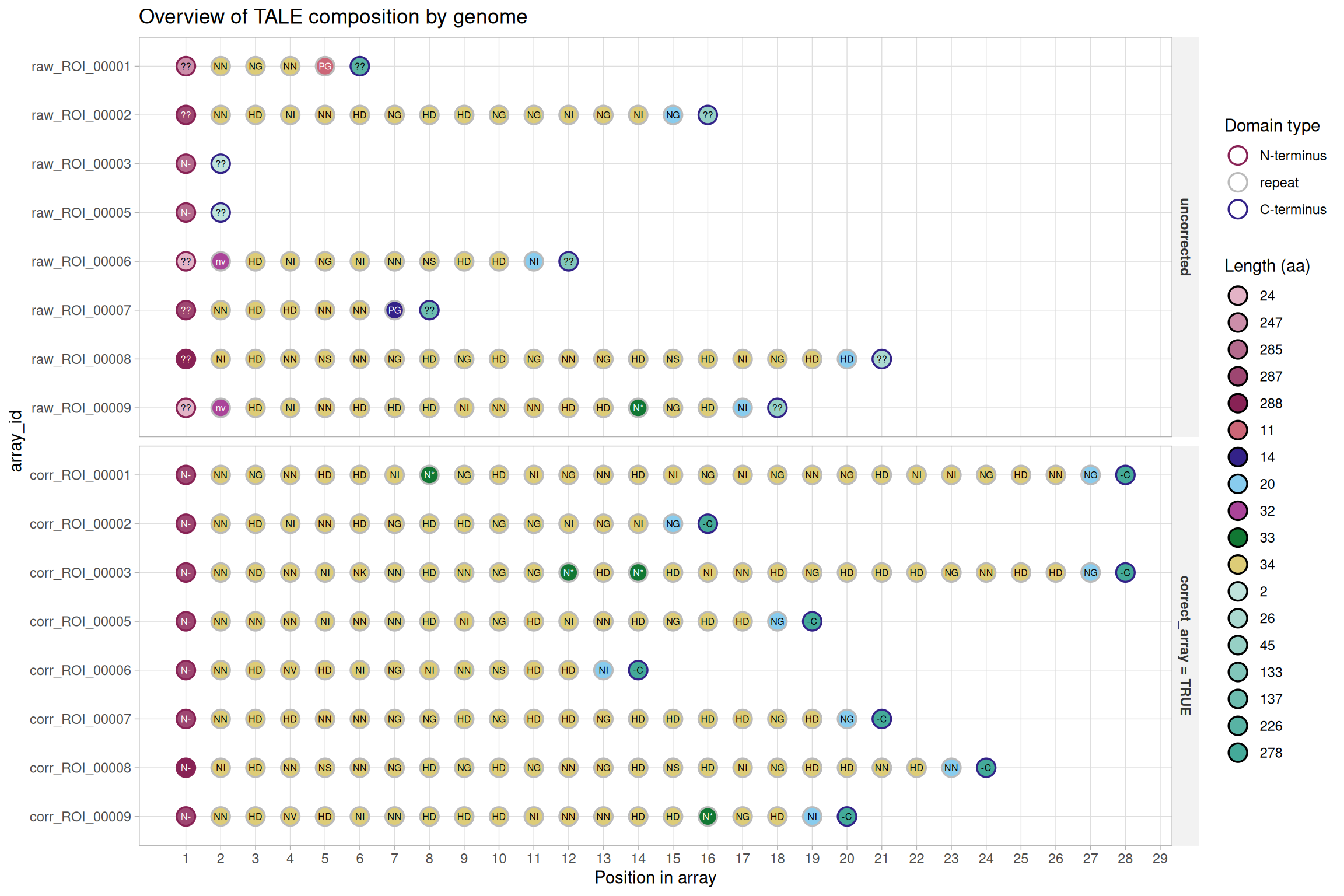
The uncorrected talome is extremely messy: most arrays have no canonical N- and C-termini, and ROI_00003 and ROI_00005 essentially encode shorter N-termini only. In contrast, the corrected arrays all display both termini with a canonical length, which suggests that these TALEs are likely to have a standard transcription activation function.
5.2 Correcting the genome, before discovery
correct_tales() takes a different, faster route. It wraps the Java TALEcorrection tool, which scans the whole input genome against profile HMMs and repairs the frameshifts it finds, before tell_tales() ever runs. As a genome-wide pre-processing step that needs no candidate arrays, it is worth trying first on a large or especially error-prone assembly (an ONT-sequenced genome, say).
Code
bai311_java_fa <- file.path(out, "BAI3-1-1_java_corrected.fa")Code
t_java <- system.time(
  corrections <- correct_tales(uncorrected_path = bai311_fa,
                               corrected_path = bai311_java_fa,
                               return_corrections = TRUE)
)
correct_tales() reports every edit it made, genome-wide, as a table of positions and inserted or deleted bases. This genome needed 70:
Code
head(corrections, 4)
#> # A tibble: 4 × 4
#>   seqName  posInOriginSeq type      substitution
#>   <chr>             <dbl> <chr>     <chr>
#> 1 contig_1        4260089 insertion - -> g
#> 2 contig_1        4260088 insertion - -> c
#> 3 contig_1        4260087 insertion - -> c
#> 4 contig_1        4259647 insertion - -> g
tell_tales() then runs on the corrected genome exactly as it would on any other, with no correct_array, because the correction already happened upstream:
Code
bai311_java_dir <- file.path(out, "BAI3-1-1_java_tell_tales")Code
t_java <- t_java + system.time(
  tell_tales(subject_file = bai311_java_fa, output_dir = bai311_java_dir,
             cterm_min_score = 300, correct_array = FALSE)
)
bai311_java <- tales_from_telltales(bai311_java_dir)
Code
tales_anomalies(bai311_java)
#> # A tibble: 2 × 4
#>   array_id  check                 kind         detail
#>   <chr>     <chr>                 <chr>        <chr>
#> 1 ROI_00006 terminus_noncanonical noncanonical N-terminus is not a canonical TA…
#> 2 ROI_00009 terminus_noncanonical noncanonical N-terminus is not a canonical TA…
correct_tales() fixes most arrays but fails to repair the N-termini of ROI_00006 and ROI_00009, which are still not canonical.
Compared with the correction made inside tell_tales(), bound the same way:
Code
tales_bind(tag_method(bai311_java, "correct_tales()", "java"),
           tag_method(bai311_corr, "correct_array = TRUE", "corr")) |>
  plot(facet_by = "method")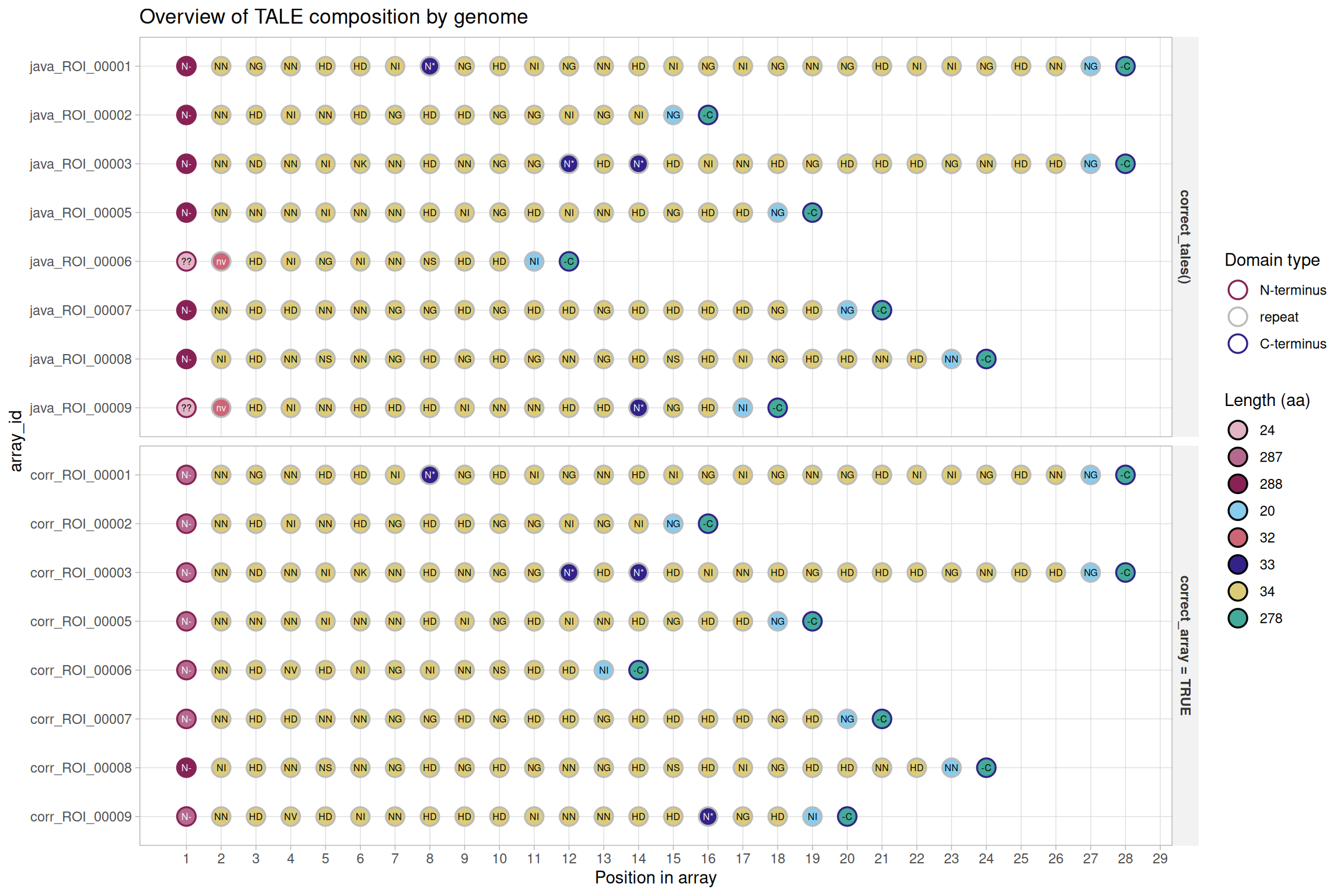
The two corrections give the same repeats everywhere except at the start of ROI_00006 and ROI_00009. After correct_tales(), both begin with a 24-aa N-terminus followed by a 32-aa repeat read as nv, and lack the NN and HD repeats that open these arrays after correction inside tell_tales(). The N-termini of five other arrays differ by one residue: 288 aa after correct_tales(), 287 aa after correction inside tell_tales().
Binding all three runs gives the lengths of every part at a glance, by domain type (columns) and correction method (rows), one colour per candidate region:
Code
tales_bind(tag_method(bai311_raw, "uncorrected", "raw"),
           tag_method(bai311_java, "correct_tales()", "java"),
           tag_method(bai311_corr, "correct_array = TRUE", "corr")) |>
  mutate(aa_length = factor(nchar(aa_seq), sort(unique(nchar(aa_seq)))),
         domain_type = factor(domain_type, c("N-terminus", "repeat", "C-terminus"))) |>
  ggplot2::ggplot(ggplot2::aes(aa_length, fill = roi)) +
  ggplot2::geom_bar(position = ggplot2::position_dodge(preserve = "single")) +
  ggplot2::facet_grid(method ~ domain_type, scales = "free", space = "free_x") +
  ggplot2::scale_fill_manual(values = unname(grDevices::palette.colors(8, "Okabe-Ito"))) +
  ggplot2::labs(x = "Length (aa)", y = "Parts", fill = "Region") +
  ggplot2::theme_light()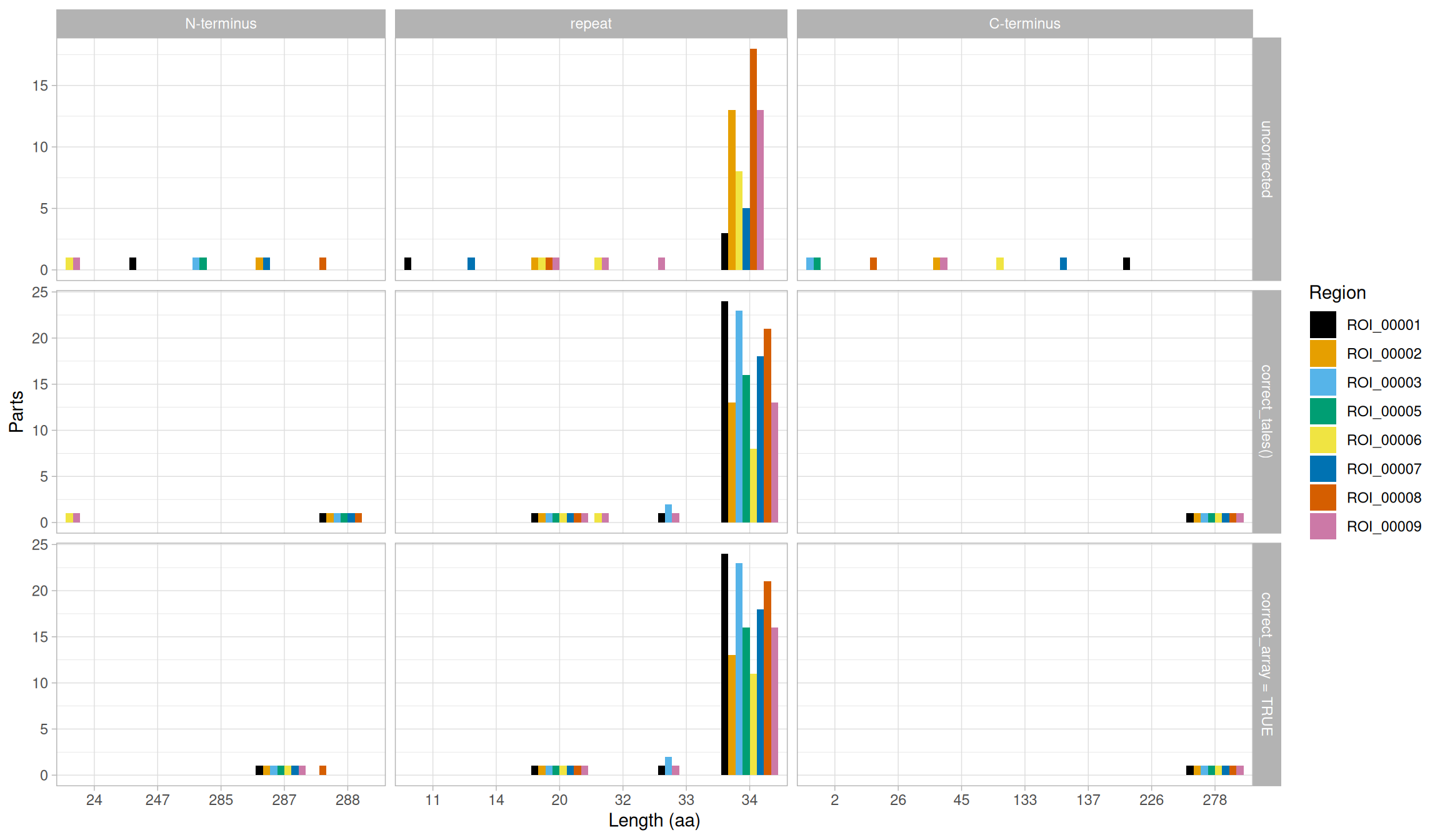
Without correction, the termini take almost any length, from 24 to 288 aa for the N-termini and from 2 to 226 aa for the C-termini, and two repeats are only 11 and 14 aa long. After either correction, every C-terminus is 278 aa long, and the repeats come back to the canonical 34 aa, the final 20-aa half-repeats and a few of 32 and 33 aa. The N-termini settle at 287 or 288 aa, except the two 24-aa N-termini that correct_tales() leaves.
5.3 What is the best method for correcting the DNA sequences of TALE arrays?
On this genome, correction inside tell_tales() gives the better result: 8 of 8 arrays come out as standard TALEs, against 6 of 8 after correct_tales(). It is also about as fast: on the machine that built this page it took 62 seconds. The Java route needs two steps, correct_tales() and then the tell_tales() run that finds the arrays in the corrected genome, and together they took 42 seconds. One genome is a limited sample, however. correct_tales() repairs the whole genome in one pass, and the corrected genome can serve other analyses as well. Furthermore, correct_tales() does not suffer the over-correction behavior exhibited by tell_tales() on truncTALEs. On a new, error-prone assembly, running both routes and comparing their tales_anomalies() costs a few minutes and shows the arrays on which they agree.
5.4 max_comparisons sets the depth of the search
max_comparisons is the main control on how long correction inside tell_tales() takes. DECIPHER::CorrectFrameshifts() ranks the references by a quick distance and aligns each array against the closest max_comparisons of them. When the cap is too low, an array whose good references rank further down is corrected against a poor one. BAI3-1-1 has one such array, ROI_00001. Measured once on this genome, against the 494 shipped references:
max_comparisons |
seconds | standard TALEs | ROI_00001 |
|---|---|---|---|
| no correction | 19 | 0 of 8 | 4 repeats, neither terminus canonical |
| 2 to 5 | 19-22 | 7 of 8 | N-terminus not canonical, 19 of its 26 repeats |
| 10, 20 | 26, 34 | 7 of 7 | not parsed by AnnoTALE |
| 50 (default) | 61 | 8 of 8 | N-terminus, 26 repeats, C-terminus |
| 100 | 101 | 8 of 8 | as at 50 |
| all 494 | 455 | 8 of 8 | as at 50 |
At 2 to 5, tales_anomalies() flags ROI_00001. At 10 and 20, AnnoTALE cannot split the corrected ORF into parts, so the array never reaches the tales object, and tales_from_telltales() warns about it:
Code
bai311_mc20_dir <- file.path(out, "BAI3-1-1_corrected_20")Code
invisible(tell_tales(subject_file = bai311_fa, output_dir = bai311_mc20_dir,
                     cterm_min_score = 300, correct_array = TRUE,
                     max_comparisons = 20))
Code
bai311_mc20 <- tales_from_telltales(bai311_mc20_dir)
#> Warning: AnnoTALE could not split 1 candidate array into parts; it is absent from the
#> result.
#> ℹ Affected array: "ROI_00001"
#> ℹ It has a TALE terminus DNA hit in 'array_report.tsv'.
#> ℹ A larger `max_comparisons` in `tell_tales()` may correct it well enough to
#>   parse.
On MAI1, BAI3 and PXO86, the other genomes shipped with the package, 50 gives the same corrected sequences as the full search. The two settings also agree where correction goes wrong: both extend the C-terminus of the PXO86 truncTALE ROI_00001 from 183 to 216 aa (details). With a reference set of your own, compare a run at the default with one at max_comparisons = NULL before relying on the cap.
6 Moving on with what you have
bai311_corr needs none of this: it is already clean. A route that stops short of that, such as correct_tales() above (which left the N-termini of ROI_00006 and ROI_00009 not canonical), still needs a decision about what to do with what remains flagged. sanitize makes it when the object is built. sanitize = TRUE removes only the arrays whose data are inconsistent or incomplete, and keeps TALEs that are merely not canonical, since a truncTALE, for one, is real biology; here it keeps both arrays, with a message:
Code
bai311_kept <- tales(bai311_java, sanitize = TRUE)
#> Kept 2 non-canonical arrays.
#> ℹ Arrays: "ROI_00006" and "ROI_00009"
#> ℹ `tales_anomalies()` lists them, with the reason.
n_distinct(bai311_java$array_id) - n_distinct(bai311_kept$array_id)
#> [1] 0
sanitize = "canonical" removes every flagged array, so that only canonical TALEs remain, with a warning naming each dropped array and the reason:
Code
bai311_clean <- tales(bai311_java, sanitize = "canonical")
#> Warning: Dropped 2 arrays that are not canonical TALEs.
#> ✖ Arrays: "ROI_00006" and "ROI_00009"
#> ℹ Reason: terminus_noncanonical
n_distinct(bai311_java$array_id) - n_distinct(bai311_clean$array_id)
#> [1] 2
What the rest of this set of articles uses
From here on, “BAI3-1-1” means
bai311_corr, the correction made insidetell_tales()(Section 5.1), alongside MAI1 and BAI3. PXO86, the fourth genome shipped with the package, is left out of the classification and alignment articles that follow: it is a distant Asian outgroup whose TALE repertoire barely overlaps the African strains’, and including it turns a clean set of one-ortholog-per-strain groups into a mix of real cross-strain groups and PXO86-only paralog clusters that do not illustrate the same thing.
7 Next
The next article picks up from a set of tales objects like the ones built here, across several genomes this time, and classifies their arrays into groups of related sequences with tales_compare_distal() and tales_group_hclust()/tales_group_kmedoids().