The previous article grouped TALE arrays by overall similarity. Grouping says arrays are related. Saying how (which repeats correspond, where one array has an insertion or a deletion relative to another) needs an alignment.
Where this fits
This article is a walkthrough: pick one real classification group and align it. The mechanics (what a
tales_msaactually is, coercion betweentalesandtales_msa, and the plotting options in full) are a deep dive in thetales_msaclass article, which continues directly from the alignment built here.
The AnnoTALE tool this package builds on can assign TALEs to classes, but cannot insert gaps while doing so. TALE arrays evolve substantially by whole-repeat duplication and deletion, so a method that cannot represent a gap is blind to exactly the events that matter most (see the QueTAL paper). tales_align() drives MAFFT in text mode instead, treating each distinct domain as one alignable symbol, which lets it open and close gaps freely.
1 The same group, from the previous article
Same three genomes (MAI1, BAI3, BAI3-1-1), same correction settings, and the same comparison and grouping as the classification article, reused here from its cached result; see the getting-started article for how these four articles are linked.
This group holds one member from each of MAI1, BAI3 and BAI3-1-1 (the same locus, present in all three related African strains) and, usefully for this article, its three copies are not identical:
2 Aligning the group
Code
msa <- tales_align(picked_group, residue_col = "dom_code")
msa
#> <tales_msa> 3 arrays, 18 alignment positions
#>   layers: rvd, dom_code   |   namespace: 5d8762602564ac93   |   8 other columns
#>                       dom_code
#>   MAI1_ROI_00007       84  35  43   5  41  31  24  49  35  54  18  40  31  ...
#>   BAI3_ROI_00007       84  35  43   5  41  31  24  49  35  54  18  40   -  ...
#>   BAI3-1-1_ROI_00006   85  35  43   5  41  31  24  49  35  54  18  40   -  ...
Code
plot(msa, tale_distances = cmp$tale_distances, domain_distances = cmp$domain_distances)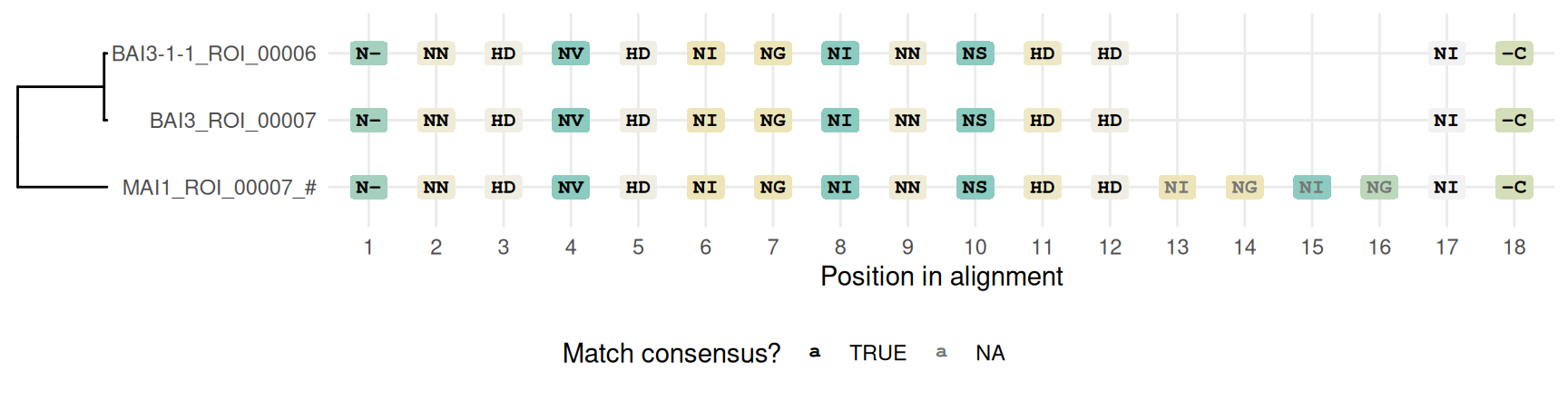
Figure 1 already shows something tales_group_kmedoids()’s single distance number could not: BAI3 and BAI3-1-1 both lack four repeats that MAI1 has, at alignment positions 13-16. The gap is internal: all three arrays end with the same 20-residue half-repeat (column 17), which lines up across the gap. BAI3-1-1 derives from BAI3, so the two share this difference.
3 Does a scoring matrix change the alignment?
tales_align() accepts a domain_distances argument: a substitution cost matrix MAFFT uses when scoring which repeats to match against each other. Without it, every mismatch counts as equally bad. Passing one is optional, and it is worth checking what it actually changes.
3.1 Aligning on dom_code
Without one, every distinct domain is as different from every other as any other pair, and MAFFT has no notion that two repeats might be more or less alike:
Code
msa_plain <- tales_align(picked_group, residue_col = "dom_code")
#> Now running MAFFT (Copyright 2002-2007 Kazutaka Katoh) on TALE array sequences.
With one, domain_distances, the domain-level protein similarity already computed by tales_compare_distal(), tells MAFFT how alike two repeats actually are:
Code
msa_scored <- tales_align(picked_group, residue_col = "dom_code",
domain_distances = cmp$domain_distances)On this group the two alignments are identical. The domain distances count the residues a half-repeat lacks against a full repeat, so the final half-repeat that BAI3 and BAI3-1-1 share with MAI1 stays opposite its identical copy (column 17), and the four-repeat gap stays internal. On more divergent arrays, the matrix lets MAFFT prefer matching similar repeats over dissimilar ones; whether that changes the alignment depends on the data, so it is worth checking as done here.
3.2 Aligning on rvd
The built-in RVD similarity matrix works the same way, opted into with domain_distances = "rvd" instead of a distance table. It scores DNA-binding specificity instead of protein sequence, so it is worth checking separately:
Code
msa_rvd_plain  <- tales_align(picked_group, residue_col = "rvd")
msa_rvd_scored <- tales_align(picked_group, residue_col = "rvd", domain_distances = "rvd")
identical(as.matrix(msa_rvd_plain), as.matrix(msa_rvd_scored))
#> [1] TRUE
On this group, aligning on RVDs also gives the same alignment whether or not the matrix is supplied. The RVD alphabet is smaller than the domain-code one (6 distinct RVDs against 12 distinct repeat codes here), and these three arrays are closely related, so there was little room for a scoring matrix to change anything. Whether either matrix matters depends on the data.
4 Other views of the same alignment
Colouring by similarity to the reference array instead of by cluster membership makes graded divergence visible where cluster identity would only say “different”:
Code
plot(msa, fill_type = "domain_sim",
    tale_distances = cmp$tale_distances, domain_distances = cmp$domain_distances)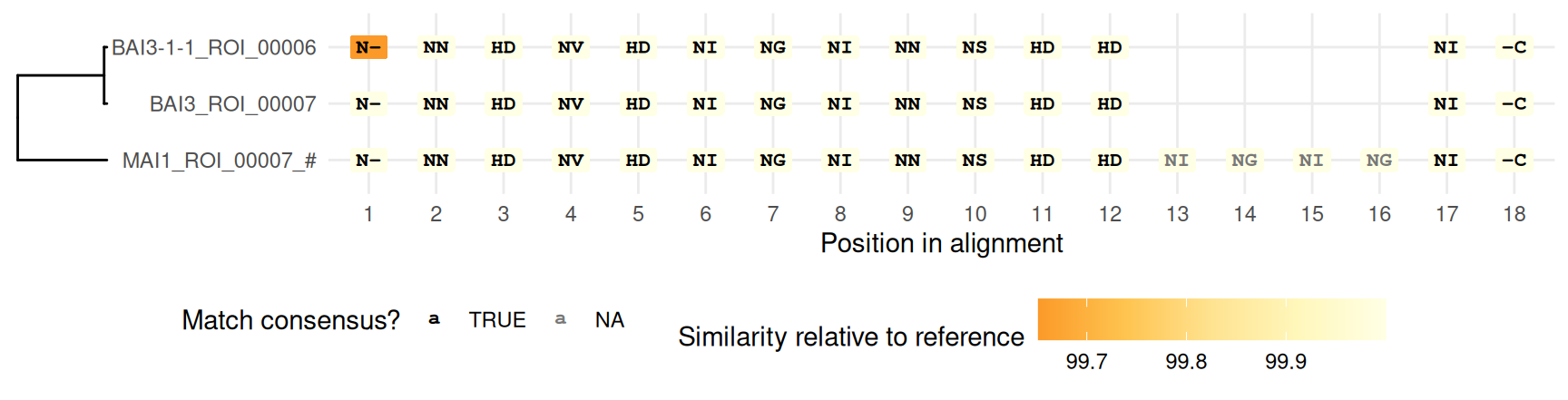
In Figure 2, every domain is identical to MAI1’s except BAI3-1-1’s N-terminus, which has its own dom_code at about 99.7% similarity. The cluster colouring of Figure 1 groups it with the other two N-termini, so the difference only shows here.
With a consensus panel attached, the column-by-column question “does this array agree with the group” is answered directly above the alignment itself:
Code
plot(msa, consensus = TRUE,
    tale_distances = cmp$tale_distances, domain_distances = cmp$domain_distances)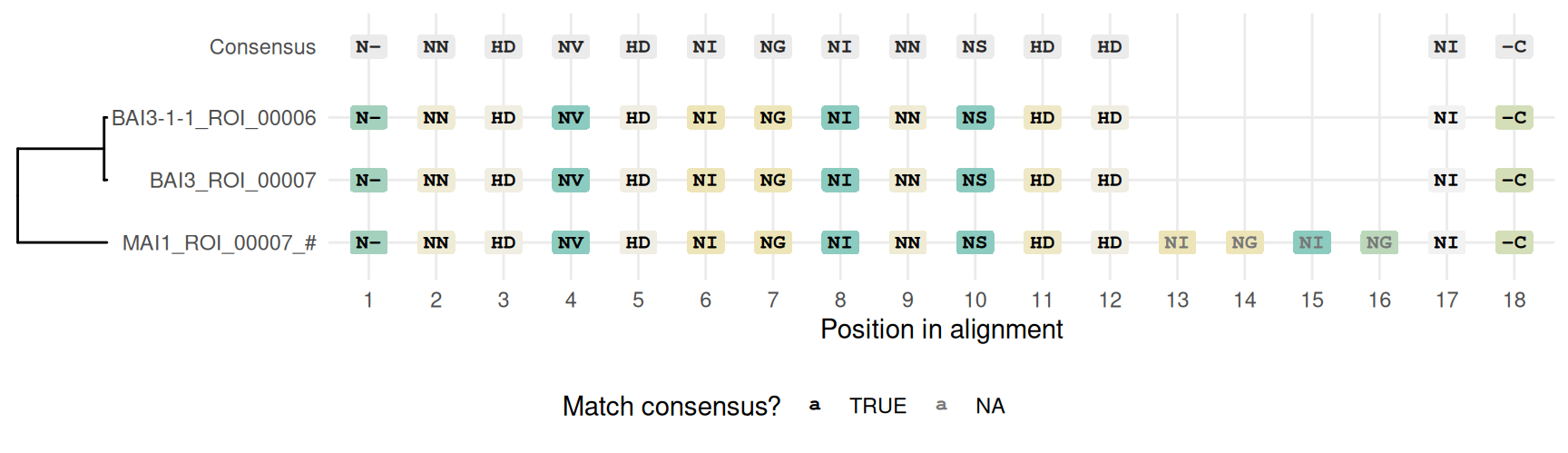
5 Next
Once related arrays are aligned, the biologically motivated next question is what DNA sequence their RVDs are predicted to bind, covered in the final article of this series. To go deeper on the alignment mechanics used here first, see the tales_msa class article.